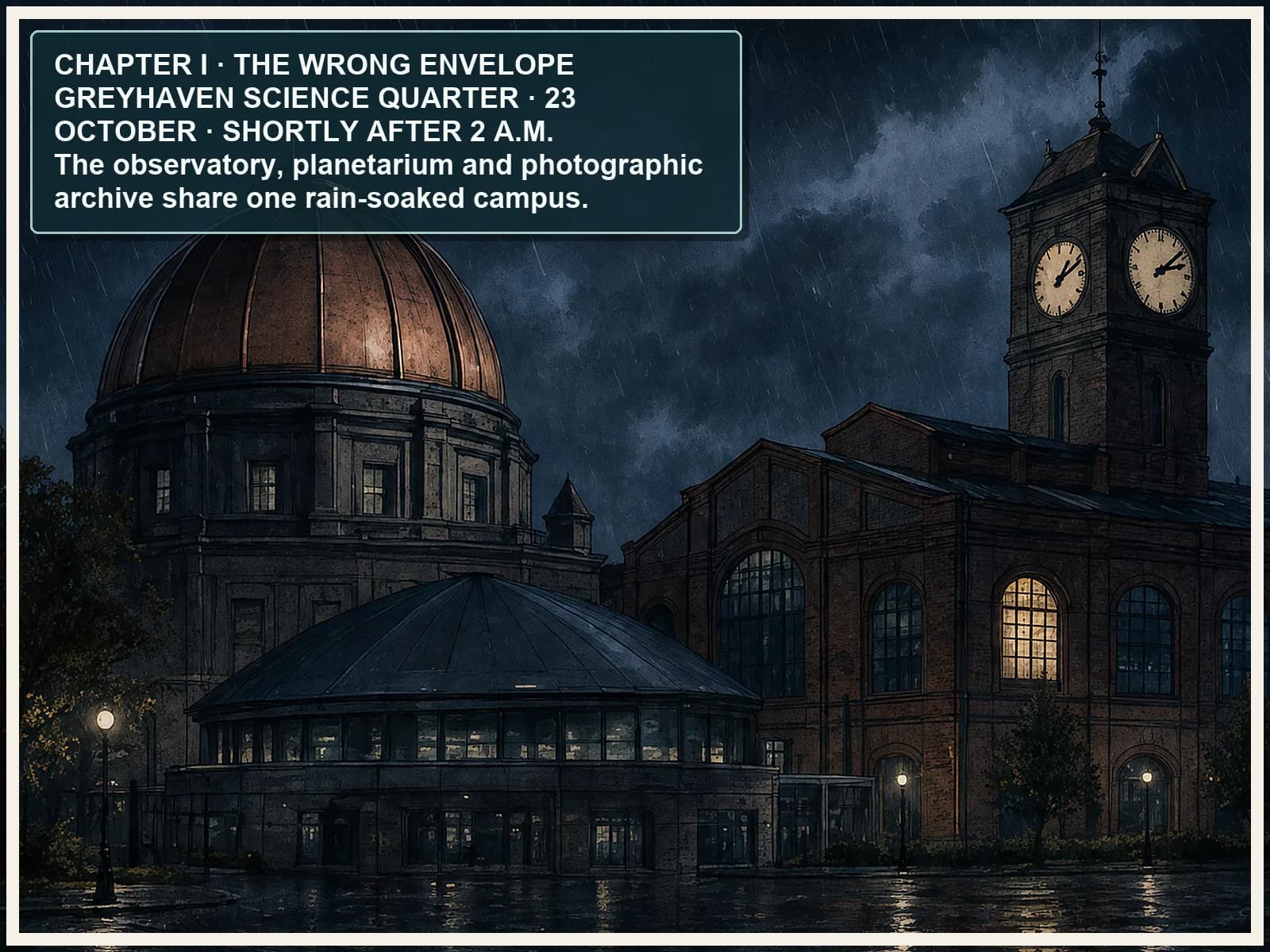
Why set a detective case at an observatory?
Greyhaven is built around precision. Its staff catalogue plates, record access and trust instruments designed to measure what the human eye cannot. That makes the observatory an ideal place for a crime whose first explanation depends on everyone accepting the wrong time and the wrong object.
The science-fiction setting raises the stakes without replacing evidence with magic. Technology leaves records. Materials have weight. Doors, alarms and clocks can disagree. The mystery comes from reconstructing how those facts fit together.
The noir is in the uncertainty
Classic noir is not only rain, shadows and hard light. It is a world of compromised witnesses, private motives and institutions eager to settle on a convenient story. Dead Orbit uses that pressure while remaining a fair-play detective comic: deception may hide misconduct, but every lie is not automatically proof of the central crime.
Ward and Reed must separate what a witness could have done from what the surviving evidence shows. Readers make the same distinction in the chapter reviews.
A sci-fi webcomic you can solve
The case begins with an eleven-minute archive breach and a single missing envelope. A later flash beneath the dome leaves one death that does not fit the official sequence. Across seven chapters, interviews, measurements and access records gradually turn atmosphere into a testable reconstruction.
If you are looking for sci-fi mystery comics, space detective games or a noir webcomic with a real ending, start at Chapter I. The first review uses only evidence from the pages you have just read.